How entity I/O works
Entity I/O is how a map makes things happen without writing code, wired the way Hammer does it for Source.
Every entity has outputs, events it announces like a button being pressed, and inputs, things you can tell it to do like a door opening. A connection says: when this output fires, call that input on a target. The wiring is saved in the map, so you hook a button to a door in the editor and the door opens in game.
A connection
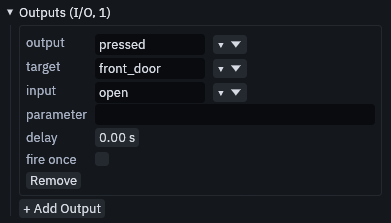
An output can hold any number of connections. Each one has these fields:
| Field | What it does |
|---|---|
| Output | The event on this entity that starts the connection, for example pressed on a button |
| Target | Which entities receive the call, usually a targetname, see Targets |
| Input | What the targets are told to do, for example open on a door |
| Parameter | An optional value handed to the input, like an amount of damage, see Parameters |
| Delay | Seconds to wait before calling the input, 0 calls it at once. Use it to stagger events, like lights coming on one after another |
| Times | How many times the connection may fire. -1 means every time, 1 makes a one shot event |
You edit them in the Inspector, under Outputs of the selected entity, or as wires in the Logic graph. Both change the same outputs. (The Inspector only has a fire once box for Times, for any other count use the connection box in the Logic graph.)
In Godot an output is a signal and an input is a method: func_button has signal pressed(activator) and func_door
has func open(). Your own scripts take part the same way, see Custom entities.
When an output fires
After Delay seconds the input is called on every node the target finds. A target that finds nothing does nothing. For a targetname or node path that is almost always a typo, so it prints a warning the first time it fires. A delayed call is dropped if its entity left the tree in the meantime, for example because it was killed.
Without a delay the whole chain runs inside the signal's emit, before the code that emitted it carries on. That
matters when your script reads state right after emitting, the doors and counters further down have already reacted.
The activator
The activator is whoever started the chain, usually the player who pressed the button or walked into the trigger.
Further down the chain !activator means that node, so a trigger can hurt or teleport exactly the one who touched it.
It is taken from the first Node argument of the signal that fired, so it only survives while every signal in the
chain passes one along. The built-in signals behave like this:
| Signals | What happens to the activator |
|---|---|
triggered, pressed, entered, exited, hurt, teleported, pushed |
Passed on unchanged, these signals carry the node that caused them |
arrived(corner), spawned(node), reached(train) |
Replaced by the node in brackets, so further down !activator is that corner, spawned node or train |
opened, timer, step_N, on_true, on_case_N, result, broken, switched, map_spawn |
Dropped. These carry no node, so from here on !activator finds nothing |
Tip
Need the player several steps down a chain that lost the activator? Target !player instead, it does not
depend on the chain.